Does Hernia Come Back After Surgery?
Direct Answer / Quick Summary
Yes, a hernia can return after surgery, but modern surgical techniques make it rare. A returning hernia is medically known as a recurrent hernia. With contemporary tension-free mesh repairs and advanced keyhole procedures, the recurrence rate has dropped to between 1% and 5%, compared to 10% to 30% with older suture repairs. Common factors contributing to recurrence include premature heavy lifting, wound infection, chronic coughing, obesity, smoking, and poor tissue healing.
Undergoing surgery of any kind requires patience, dedication to recovery, and clear information. For individuals diagnosed with an abdominal or groin hernia, corrective surgery offers vital relief from pain, visible bulging, and serious risks like intestinal strangulation. Yet, during recovery, almost every patient wonders: does hernia come back after surgery?
It is an understandable worry. Many ask, can a hernia come back after surgery, and after hernia surgery can it come back even if you followed your surgeon's directions? While surgical repair is one of the most effective and commonly performed procedures in modern medicine, no surgery offers an absolute zero-risk guarantee. By understanding how hernias heal, what causes them to recur, and how you can protect your abdominal wall, you can navigate your recovery with total confidence.
What Is a Recurrent Hernia?
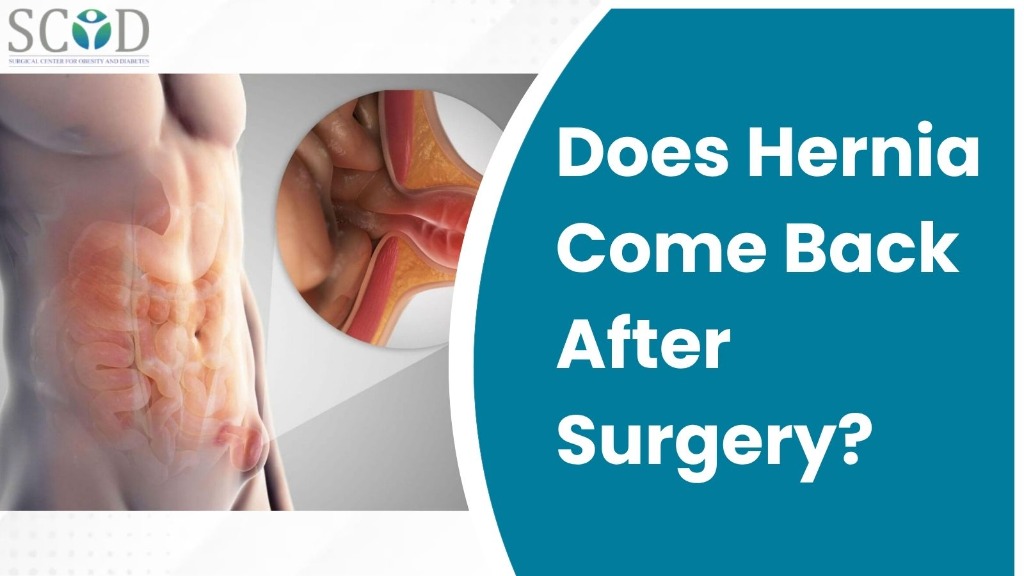
An abdominal or groin hernia occurs when internal tissue—such as loops of the intestine or protective fatty layers—protrudes through a weak spot or opening in the surrounding muscle wall.
During a primary hernia operation, the surgeon gently pushes the protruding organ back into place and repairs the muscle defect. In modern surgery, this repair almost always includes a sterile prosthetic mesh that reinforces the weakened wall like a protective patch.
A recurrent hernia happens when that original repair breaks down, tears, or gives way, allowing tissue to push through the abdominal wall once more. Recurrence can affect different types of hernias:
Inguinal Hernia (Groin)
The most common variety. A recurrence usually causes a lump in the groin crease or upper scrotum.
Umbilical Hernia (Navel)
Located at the belly button. Read our detailed guide on umbilical hernia care.
Incisional / Port-Site Hernia
Develops through a former surgical scar. See our resource on keyhole surgery hernias.
Femoral & Epigastric Hernias
Found in the upper thigh or upper midline abdomen, these defects can also recur if excessive mechanical stress is placed on the repair.
How Common Is Hernia Recurrence? (Comparing the Numbers)
Patients are often relieved to learn that hernia recurrence is uncommon today. In previous decades, surgeons performed "tension repairs" by pulling the edges of torn muscle together with stitches. Under high internal pressure from coughing or lifting, these stitches often pulled through fragile muscle tissue, leading to recurrence rates of 10% to 30%.
The modern gold standard is the tension-free mesh repair. By covering the gap with an inert, flexible mesh scaffold, the repair experiences no pulling tension. Fibrous tissue naturally grows into the mesh pores, creating a durable composite wall. When performed laparoscopically, the mesh is placed behind the defect, where natural intra-abdominal pressure keeps it securely positioned.
| Repair Technique | Recurrence Rate | Key Characteristics |
|---|---|---|
| Suture-Only Repair (No Mesh) | 10% – 30% | High tension on muscle edges; significant risk of sutures pulling through tissue. |
| Open Tension-Free Mesh Repair | 3% – 5% | Durable mesh bridge; performed via a standard open incision. |
| Advanced Laparoscopic Mesh Repair | 1% – 3% | Keyhole placement behind the muscle wall; minimal pain; lowest recurrence with expert surgeons. |
These statistics confirm that between 95% and 99% of patients who undergo modern mesh repairs enjoy lifelong relief without recurrence.
Why Does Hernia Come Back After Surgery? Key Causes
A hernia does not return by chance. When recurrence occurs, it is typically driven by a combination of physical strain, systemic health conditions, and surgical factors:
1. Premature Heavy Lifting and Physical Strain
Following surgery, your body requires 6 to 8 weeks to weave new collagen fibers securely through the mesh pores. Lifting heavy weights, moving heavy items, or returning to strenuous workouts too soon creates sudden intra-abdominal pressure that can dislodge the mesh or tear healing tissue before it achieves full tensile strength.
2. Repetitive High Intra-Abdominal Pressure
Frequent, sharp spikes in abdominal pressure subject the repair line to repeated mechanical stress:
- Chronic coughing: Common in smokers, asthmatics, and patients with allergies or bronchitis.
- Severe constipation: Straining during bowel movements exerts downward force on the lower abdominal wall.
- Urinary straining: An enlarged prostate (BPH) causes men to strain during urination.
3. Surgical Site Infection
If an infection develops, inflammatory enzymes degrade healing collagen, disrupting tissue ingrowth into the mesh and leaving the muscle layer weak.
4. Patient Health and Lifestyle Factors
Systemic conditions greatly influence healing:
- Obesity: Excess visceral fat exerts continuous outward pressure on the abdominal muscles.
- Smoking: Nicotine restricts blood flow, impairing collagen synthesis and multiplying recurrence risk.
- Diabetes: Elevated glucose impairs immune defenses and delays healing.
- Poor Nutrition: Insufficient protein limits the essential building blocks for tissue repair.
5. Mesh Sizing and Surgical Technique
Adequate mesh overlap beyond the defect edges (typically 3 to 5 cm) is critical. If overlap is insufficient or fixation is loose, tissue can slip past the mesh edge, highlighting the value of choosing a fellowship-trained laparoscopic surgeon.
Warning Signs: How to Spot a Recurrent Hernia
Detecting a recurrent hernia early allows for prompt medical evaluation. Key symptoms to watch for include:
-
A Visible or Palpable Bulge:
A soft bulge reappears at or near your previous incision. It becomes more prominent when standing, coughing, or bending, and tends to recede when lying flat.
-
Dull Aching or Dragging Sensation:
Persistent heaviness, mild tenderness, or an aching sensation that increases toward the end of an active day.
-
Discomfort with Exertion:
Lifting objects, climbing stairs, or laughing causes discomfort at the surgical scar that had previously subsided.
Post-Op Seroma vs. Recurrent Hernia: How to Tell
In the first few weeks after surgery, the body often creates a harmless fluid pocket called a seroma where the hernia sac used to sit. This fluid can feel like a lump and cause worry.
However, a seroma gradually decreases in size and disappears over 4 to 8 weeks, whereas a recurrent hernia persists or grows and bulges outward when you cough. A quick clinical check or ultrasound readily clarifies the diagnosis.
Emergency Red Flags: Incarceration & Strangulation
If protruding tissue becomes trapped in the muscular opening, blood supply can become compromised. Seek emergency medical care immediately if you notice:
- Sudden, severe, escalating pain at the hernia site
- A lump that becomes firm, purple, dark red, or cannot be pushed back inside
- Nausea, repeated vomiting, or fever
- Inability to pass gas or have a bowel movement
How Is a Recurrent Hernia Diagnosed?
Diagnosing a recurrent hernia is straightforward and begins with a specialist consultation:
- Physical Examination: The surgeon palpates the scar while you lie down and stand, asking you to cough or bear down to check for an expansile impulse.
- Ultrasound Imaging: A quick, non-invasive ultrasound confirms whether the protrusion contains fluid, fat, or bowel loops.
- CT Scan: Recommended for complex or incisional recurrences to visualize abdominal wall anatomy, prior mesh positioning, and defect size in clear cross-section.
Treatment Options: How Is a Recurrent Hernia Fixed?
It is crucial to know that a recurrent hernia can be successfully repaired. Exercises, belts, or medications cannot heal the anatomical opening. However, modern revision techniques deliver outstanding, durable results.
Because previous surgery creates internal scar tissue, revision repairs require specialized surgical skill. Today, minimally invasive Laparoscopic Hernia Surgery in Delhi is the treatment of choice for recurrent hernias.
The Laparoscopic Advantage
Laparoscopy allows the surgeon to approach the abdominal wall from the inside (preperitoneal plane), bypassing prior scar tissue. This reduces post-operative pain, minimizes wound infection risks, and allows comprehensive inspection of the abdominal wall.
Advanced Prosthetic Meshes
Surgeons utilize cutting-edge 3D anatomical meshes and dual-surface composite barriers that safely prevent intestinal adhesions while promoting robust, permanent tissue ingrowth.
Under the clinical leadership of leading laparoscopic and bariatric specialist Dr. Arush Sabharwal, SCOD Clinic utilizes advanced imaging, precision keyhole techniques, and individualized rehabilitation protocols to ensure permanent abdominal wall restoration.
Proven Strategies to Prevent Hernia Recurrence
While your surgical team provides meticulous technical repair, your post-operative self-care is equally vital in preventing recurrence:
Avoid lifting anything over 4 to 5 kg (10 lbs) for the first 4 to 6 weeks. Reintroduce weights gradually under medical supervision.
Eat a fiber-rich diet and stay hydrated. Discover dietary recommendations in our guide on post-surgery diet tips.
Hold a pillow gently against your stomach when coughing, sneezing, or laughing to cushion your healing abdominal muscles.
Gentle walking stimulates intestinal motility and circulation. Learn more in our article on relieving surgical gas.
Achieving a stable, healthy weight reduces chronic tension and intra-abdominal strain on your surgical site.
Quitting improves tissue oxygenation, boosts collagen synthesis, and eliminates chronic coughing.
Interested in the broader safety profile of keyhole procedures? Explore our clinical review on laparoscopic surgery safety.
Frequently Asked Questions (FAQs)
1. Can a hernia come back after surgery with mesh?
Yes, although it is uncommon. Modern surgical mesh has lowered recurrence rates to between 1% and 5%. Recurrence with mesh can occur if heavy lifting happens prematurely, an infection develops, or the patient's tissues fail to integrate into the mesh.
2. Does hernia come back after surgery if I lift something heavy?
Lifting heavy items during the first 4 to 6 weeks is one of the most common causes of hernia recurrence. The body needs at least 6 to 8 weeks for collagen to weave into the mesh. Straining early can tear new scar tissue or pull the mesh away from the muscle.
3. After hernia surgery can it come back in the exact same spot?
Yes. A recurrent hernia frequently develops at the exact site of the initial surgery, usually along the border of the previous mesh or suture line where natural tissue experienced mechanical stress.
4. How long after surgery can a hernia come back?
A recurrent hernia can appear within months or years. Many recurrences manifest within the first 1 to 3 years due to early healing disruptions. However, late recurrences can occur decades later as muscle tissues naturally thin with age or after weight gain.
5. What does a recurrent hernia feel like?
Patients usually notice a soft bulge near the surgical scar accompanied by a dull ache or dragging feeling when standing, coughing, or bending. The lump typically becomes more prominent with physical exertion.
6. Is it more difficult to fix a hernia the second time?
Second-time surgery is technically more complex because of existing scar tissue. However, skilled laparoscopic surgeons can enter through untouched tissue planes, allowing safe, effective repair with fast recovery times.
7. Can a recurrent hernia go away on its own with exercise or diet?
No. Hernias are structural tears in the muscle wall. Abdominal workouts and diet cannot close the opening and can even worsen it by increasing intra-abdominal pressure. Surgery is the only permanent solution.
8. When should I see a doctor if I suspect my hernia came back?
Consult a hernia specialist promptly if you notice an unexplained bulge or persistent discomfort near your scar. Seek emergency care immediately if the lump becomes firm, red, painful, or is accompanied by nausea and vomiting.
Conclusion & Expert Care at SCOD Clinic
Learning that a hernia can return might feel daunting, but modern surgical techniques have made recurrence remarkably rare. With tension-free mesh, advanced keyhole procedures, and diligent adherence to recovery guidelines, more than 95% to 99% of patients achieve permanent, complication-free relief.
If you have noticed a bulge near an existing incision, are experiencing discomfort, or wish to explore second-opinion options, the expert team at SCOD Clinic is here to support you. Led by renowned surgical expert Dr. Arush Sabharwal, SCOD Clinic provides world-class evaluations, advanced imaging, and cutting-edge Laparoscopic Hernia Surgery in Delhi. Contact us today to schedule your consultation and restore your abdominal health with confidence.